


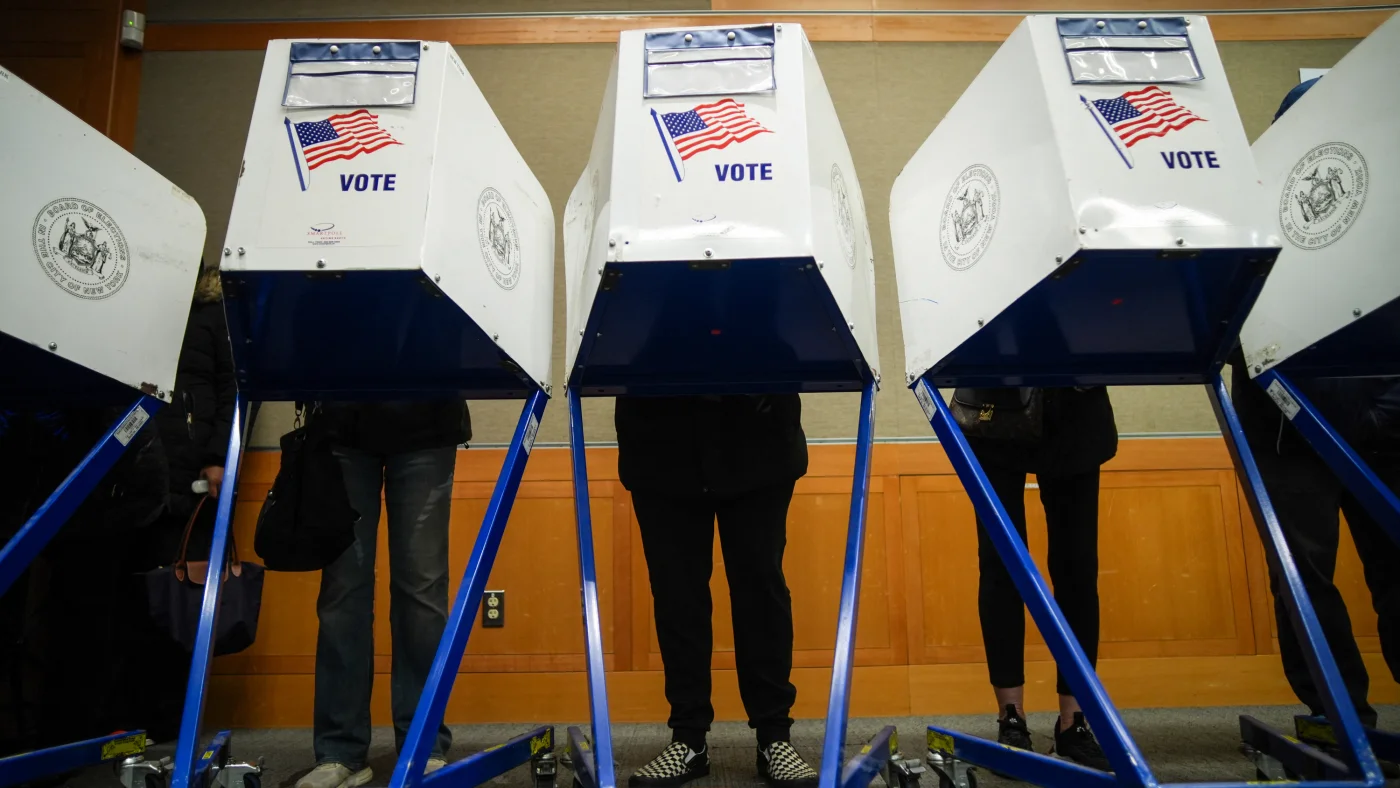
Democrats appear poised to regain control of the US House of Representatives, but the results will show whether their gains amount to a broad electoral wave or only a narrow shift in power.
Republicans entered election day with a 218-214 advantage and the disadvantage of being the governing party. The midterm campaign has also been marked by an unusually high number of congressional departures, while polling has indicated dissatisfaction with the economy and the continuing war in Iran.
About 70 districts have emerged as competitive, ranging from established toss-ups to seats in deeply conservative areas that have become unexpectedly vulnerable. The first results from a handful of contests could provide an early indication of the scale of any Democratic advance.
Early results that could set the tone
Kentucky’s 5th Congressional District and Indiana’s 5th are among the first races expected to report, with polls closing during the 6pm hour Eastern Time. Donald Trump carried the districts by 15 and 17 points respectively in 2024, making them an early test of whether support for Republicans has weakened significantly.
The Kentucky contest has attracted substantial spending from both parties, with Democrat Zach Dembo challenging Republican Ralph Alvarado. A Democratic victory in either race would point to a difficult night for Republicans, while wins in both would intensify concern about the party’s wider prospects.
Florida is also expected to count and report quickly. More than half a dozen of its districts are regarded as toss-ups or as leaning slightly towards one party, offering an early guide to contests elsewhere.
Among the closely watched Florida races are the open seat in the 22nd District, where Democrat Pia Dandiya is facing Republican Casey Askar, and the newly redrawn 25th District, where Democratic incumbent Jared Moskowitz is taking on Republican Scott Singer.
Late spending highlights battlegrounds
The closing week of the campaign has brought more than $10 million in advertising to a number of House races, according to AdImpact. The spending has concentrated on districts where turnout is expected to decide contests that remain finely balanced.
Michigan is home to two of the most closely watched races. In the seventh district, progressive Democrat William Lawrence is challenging Republican incumbent Tom Barrett in a seat Trump won by just over one percentage point in 2024. In the open 10th District, Democrat Christina Hines is facing Republican Mike Bouchard.
New York Republican Mike Lawler is among the incumbents whose prospects may have been helped by a late advertising advantage for his party. He is defending the 17th District against Democrat Cait Conley.
Three of Iowa’s four House races – the first, second and third districts – are also among the most expensive contests, partly because competitive governor and Senate races are expected to boost turnout.
Redrawn maps put seats under pressure
Changes to congressional boundaries have added another layer of uncertainty. A Supreme Court decision rolling back part of the Voting Rights Act was followed by Republican-led states redrawing maps to remove districts that would normally favour Democrats.
However, the political climate has shifted enough to put several of those newly configured seats in play. Democratic-held districts in Alabama, Ohio and North Carolina are now rated as toss-ups or as leaning towards the Democrats, rather than providing Republicans with the advantage the new boundaries were intended to create.
In Texas, a reported shift among Latino voters towards Democratic candidates could prevent Republican Eric Flores from taking Vicente Gonzalez’s seat in the 34th District. It could also help Democratic incumbent Henry Cuellar withstand a challenge from Tano Tijerina in the 28th District.
The contests in California’s 22nd, Florida’s ninth and 14th, and Texas’s 35th districts are also being closely monitored as the impact of redistricting becomes clearer.
How far can Democrats reach into conservative areas?
The outer limits of the Democratic advance will be measured in districts that remain firmly conservative on paper. In Arkansas’s second district, Republican incumbent French Hill is facing Democrat Chris Jones, a well-known challenger, in a seat Trump won by 15 points in 2024.
Almost $10 million is expected to have been spent on the Little Rock-based contest during the final months of the campaign, an indication of the attention it has received despite its Republican lean.
Ohio offers another test of whether Republican map-making could backfire. In the 10th District, held by Mike Turner, and the 15th, held by Mike Carey, Trump’s 2024 margin was closer to 10 points. Both districts span suburban and exurban areas around Dayton and Columbus and are also affected by competitive statewide races.
In North Carolina, the result of the Senate contest between former governor Roy Cooper and former Republican National Committee chair Michael Whatley could help determine whether districts such as the third are genuinely competitive. Republican-held areas including the ninth and third districts have absorbed more Democratic-leaning voters under the latest map.
The eventual House balance will therefore depend not only on the traditional battlegrounds, but on whether Democratic support extends into districts that were designed to remain safely Republican. The difference between a small majority and a sweeping takeover could be measured across those outer edges of the map.
