


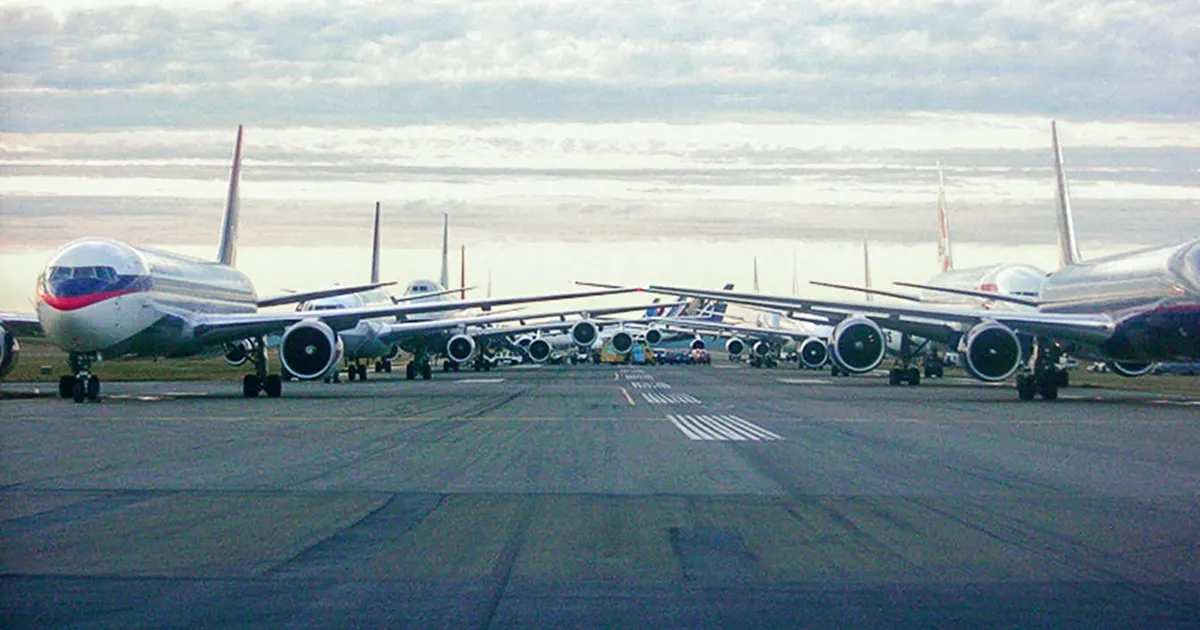
The nationwide FAA ground stop on Friday, 13 November 2026, was only the second such order since the 11 September 2001 terrorist attacks, when the United States shut its airspace in an unprecedented effort to bring thousands of aircraft safely back to the ground.
The latest disruption was blamed on a temporary telecommunications outage affecting air traffic control operations. Unlike the emergency response after 9/11, it halted departing flights rather than ordering every aircraft already in the sky to land.
How the FAA ground stop unfolded on 11 September 2001
Within minutes of the first hijacked aircraft striking New York’s World Trade Centre, the Federal Aviation Administration began restricting traffic around the city and warning pilots about the possibility of cockpit intrusions.
At 9.25am, the FAA banned civilian take-offs nationwide. Twenty minutes later, at the direction of transportation secretary Norman Mineta, the FAA Command Centre ordered all aircraft in US airspace to land at the nearest suitable airport as soon as practicable.
More than 4,500 aircraft were airborne when the order was issued. Air traffic controllers landed about 700 planes within four minutes, 2,800 during the first hour and the remainder within roughly three hours, according to the FAA.
By shortly after midday, the skies over the 48 contiguous states had been cleared of commercial and private flights. The operation brought more than a million passengers safely to the ground, despite the scale and speed of the emergency.
Aircraft bound for the US from overseas were either turned back or diverted. Planes that lacked sufficient fuel to return to their departure airports were sent to Canada, where authorities launched Operation Yellow Ribbon.
Operation Yellow Ribbon and the planes diverted to Canada
Transport Canada directed 224 flights carrying more than 33,000 passengers to airports across the country. Other figures compiled by NAV Canada put the number of diverted aircraft at 238, with flights sent to 17 airports, including Halifax, St John’s, Vancouver and Gander.
Halifax Stanfield International Airport received 40 aircraft carrying about 8,800 passengers and crew. At Gander International Airport in Newfoundland, 38 planes arrived carrying thousands of people in a town whose population was smaller than the number of stranded travellers.
Gander had nowhere near enough hotel rooms to accommodate them. Residents responded by opening schools, churches and community buildings, while local businesses and volunteers provided food, clothing, bedding and access to telephones.
Pharmacies supplied medicines without charge to passengers who needed prescriptions. The town also organised showers, meals, entertainment and transport, while food was stored inside an ice rink that was described by the local mayor as the country’s largest walk-in freezer.
The response later became internationally known through the musical Come From Away, which tells the story of the passengers and the Newfoundland communities that took them in.
US airspace reopened under tighter security
Limited commercial flights resumed on 13 September 2001, two days after the attacks, following extensive security checks and new restrictions. Ronald Reagan Washington National Airport remained closed to commercial traffic until 4 October because of concerns surrounding the US capital.
The FAA’s historical account describes the work of air traffic controllers as one of the greatest achievements in the history of aviation control. Controllers had to manage an unprecedented number of aircraft, redirect international traffic and maintain order while the nature of the threat was still unfolding.
In a message to staff the following week, Bill Peacock, then the FAA’s director of air traffic, praised employees for showing “great strength and purpose” while protecting passengers and maintaining the safety of the country.
John Carr, president emeritus of the National Air Traffic Controllers Association, said the safe landing of the aircraft represented “the single greatest feat in all of ATC history”.
The nationwide order issued on 13 November 2026 was markedly different from the 9/11 closure. The FAA said international arrivals would be handled on a case-by-case basis, while planes already airborne were not subjected to the wholesale diversion programme used after the attacks.
Before Friday, the most recent nationwide FAA ground stop had been issued on 11 January 2023 after a failure in the agency’s Notice to Air Missions system. That incident also affected departures, rather than closing the entire US airspace system as the 11 September 2001 emergency did.
