


A nationwide US ground stop triggered widespread travel disruption after the Federal Aviation Administration (FAA) halted all departing flights for more than four hours, forcing the cancellation of more than 8,000 services and delaying thousands more.
The order, issued on Friday afternoon in Washington, allowed aircraft already in the air to land but prevented planes on the ground from taking off. The disruption spread beyond the United States, with flights from Canada and Europe also cancelled, while services departing Australia for the US were temporarily halted before resuming.
US airspace handles about 45,000 flights a day. Although the ground stop was lifted at 8.15pm Washington time, airlines faced a substantial backlog of passengers and aircraft heading into the weekend.
Transportation Secretary Sean Duffy said the FAA had acted after a communications problem affected all Air Route Traffic Control Centres. He said intermittent failures involving radar and communications systems meant the agency could not safely track or contact aircraft.
“It wasn’t a complete blackout … but when you have issues, and you can’t immediately communicate and immediately see where aircraft are at, that’s a risk that we are unwilling to tolerate,” Mr Duffy said at a White House news conference.
He blamed ageing and overloaded infrastructure for the failure, saying routers had become overwhelmed with data and begun producing inconsistent information.
“We have old switches, old routers. We use 1980s little copper lines. It’s an old system that went down. It went down everywhere. It got overloaded,” he said.
Technicians developed a fix which reduced the pressure on the network switches. Mr Duffy said the repair provided a “pretty good indication” that the problem had been caused by the FAA’s legacy network.
Homeland Security Secretary Markwayne Mullin said there was no indication that a cyberattack or a rogue artificial intelligence system was responsible. He said nothing could be conclusively ruled out at that stage, while stressing that the incident was not connected to an outage affecting Microsoft systems the previous day.
FAA seeks emergency funding after nationwide ground stop
The Trump administration used the disruption to press Congress for increased funding to replace the FAA’s ageing systems. Congress approved US$12.5 billion last year for improvements to the communications network, while the FAA and the White House had sought a further US$30.1 billion for other problems before Friday’s failure.
Mr Duffy said he now wanted US$50 billion in emergency funding. He added that switches installed during the Trump administration had not failed, and that only older equipment was affected.
The FAA has also begun introducing an air-traffic management tool called Strategic Management of Airspace, Routes and Trajectories, or SMART. The system was first rolled out in Washington in September and expanded to other areas only days ago.
The ground stop was only the third nationwide order of its kind in US history. The first followed the terrorist attacks of September 11, 2001, while the second came in 2023 when the FAA’s Notice to Air Missions system failed.
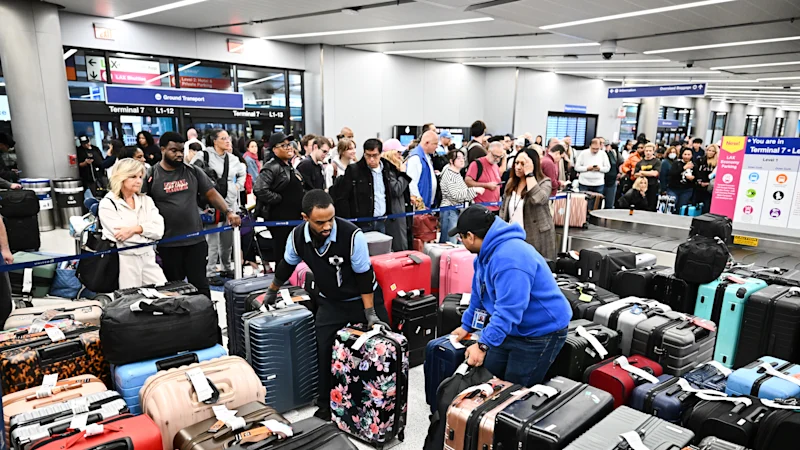
At airports across the country, passengers waited in crowded terminals and at gates while aircraft remained parked. Some travellers were required to leave planes on the tarmac, while others abandoned their journeys and returned home or paid for hotel rooms.
Mr Duffy said he expected normal operations to resume by the following Friday, shortly before the start of the busy Thanksgiving holiday travel period.
