


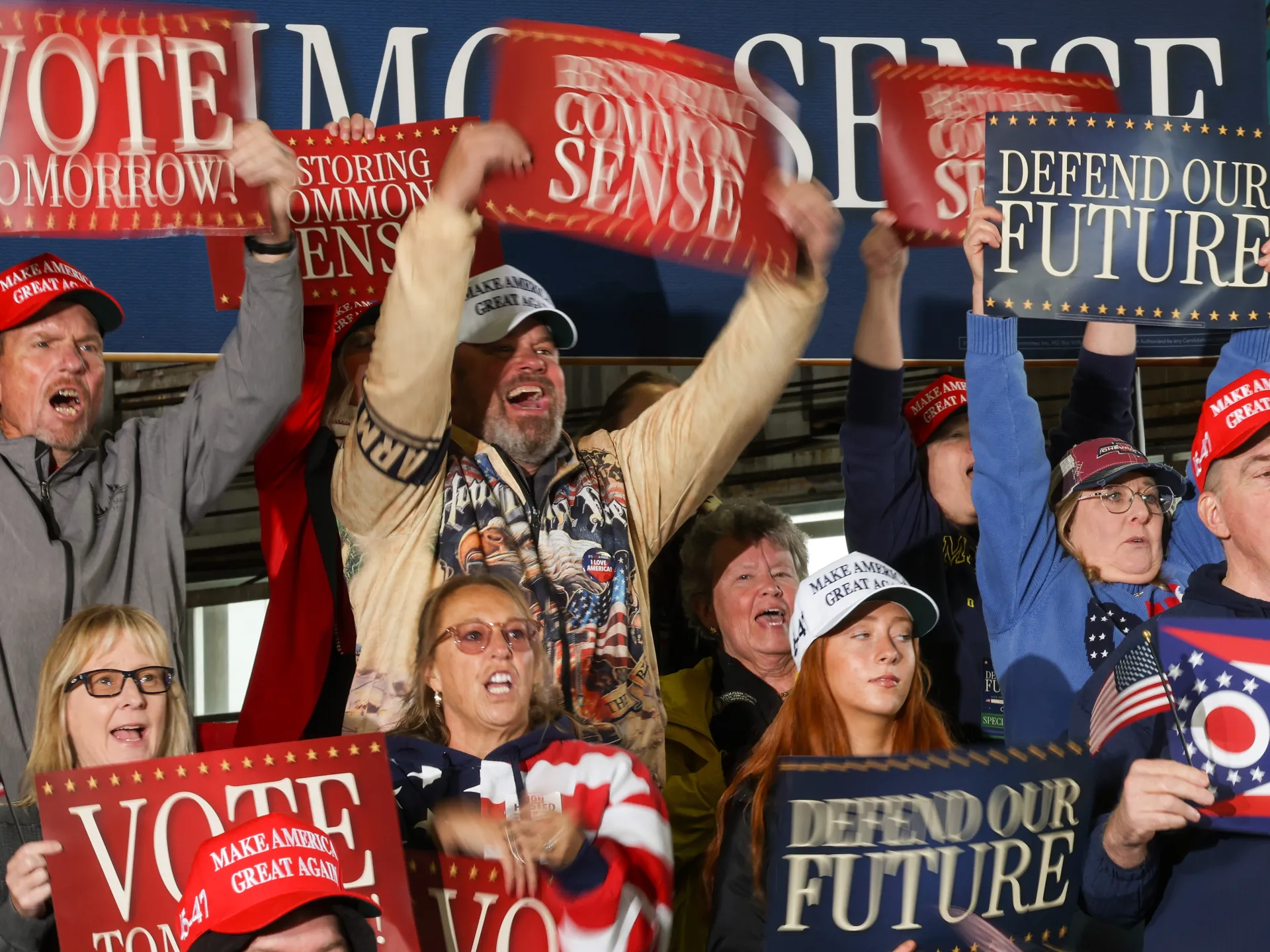
Polls ahead of the US midterm elections suggest that the economy and cost of living are the issues most likely to shape Tuesday’s vote, while Democratic candidates hold an advantage in preferences for control of Congress.
Surveys also point to a sharp divide between Democrats and Republicans over President Donald Trump’s economic record, immigration, healthcare and the state of American democracy.
US midterm elections dominated by economic concerns
About 84% of registered voters told the Pew Research Centre that the economy was very important to their midterm choice. The issue was cited by 88% of voters who favoured Democrats and 82% of those who preferred Republican candidates.
An NBC poll released on Sunday found that 75% of respondents were dissatisfied with the state of the US economy. More than half, or 51%, said they were dissatisfied with their own financial situation.
It was the first time in three decades of NBC polling that dissatisfaction with personal finances had exceeded satisfaction.
Other surveys showed the pressure being felt by households. In an NPR, PBS News and Marist poll, 38% of likely voters said their finances had worsened over the previous year, while 44% said they had remained broadly unchanged and 15% said they had improved.
Among likely Democratic voters, 51% said their finances had deteriorated, compared with 21% of Republicans. A Reuters/Ipsos survey found that 71% of Democrats and 57% of Republicans believed their incomes had failed to keep pace with rising prices.
The cost of essential goods and services was a concern for majorities in both parties, although Democrats were more likely to express anxiety about prices. Food and consumer costs worried 82% of Democrats and Democratic-leaning voters, compared with 62% of Republicans and Republican-leaning voters.
Healthcare costs concerned 80% of Democrats and 57% of Republicans, while petrol and energy prices were an issue for 81% of Democrats and 65% of Republicans.
A Fox News poll found that 74% of registered voters viewed the economy negatively, with 60% identifying the cost of living as their biggest economic concern. Even among Republicans, 53% told NBC they were dissatisfied with the state of the economy.
Eric Ham, a former Democratic congressional staffer and Senate national security adviser, said tariffs introduced by Mr Trump and the US-Israel war on Iran had increased financial pressure on households.
“Americans are paying more not just in terms of self-inflicted wounds that President Donald Trump implemented through tariffs, but also if you look at this war of choice,” Mr Ham said.
Parties divided over Trump and key election issues
Views of Mr Trump’s economic policies remain closely aligned with party loyalty. In the Pew survey, 91% of Democratic respondents and Democratic-leaning voters said his policies had made economic conditions worse.
Republican voters were more divided: 39% said his policies had improved the economy, 35% said they had made it worse and 25% believed they had had little effect.
Overall, 40% of registered voters approved of Mr Trump’s job performance in the NBC poll published on November 1, while 60% disapproved.
The parties also placed different emphasis on issues beyond the economy. Some 85% of Democratic supporters said the future of democracy was very important to their vote, compared with 69% of Republicans.
Healthcare was a priority for 82% of Democrats and 53% of Republicans. Immigration was regarded as very important by 72% of Republicans, compared with 53% of Democrats, while violent crime was cited by 64% of Republicans and 37% of Democrats.
Democratic voters were more likely to trust their party to deal with healthcare costs, by 42% to 22%, according to a Kaiser Family Foundation survey. Democrats also led Republicans on handling the cost of living, with 39% trusting them more compared with 25% for the Republicans.
The Pew survey found that abortion and gun policy were less central to Democratic voters than they had been in 2022. Among Republicans, education and energy policy had also fallen in importance compared with four years earlier.
Democrats report stronger motivation to vote
Democratic voters appeared more enthusiastic about participating in the election than Republicans and independents. In the Marist poll, 91% of likely Democratic voters said they were enthusiastic or very enthusiastic, compared with 86% of Republicans and 76% of independents.
A separate KFF survey found that 63% of Democratic supporters described themselves as more motivated than usual to vote, against 38% of Republican supporters.
John Fury, a former Republican congressional staffer, said the final phase of campaigning had concentrated on turnout rather than changing minds.
“This is not a persuasion election. This is a get-out-the base election,” Mr Fury said.
Interest in the contest was nevertheless high overall, with 70% of registered voters giving their interest a rating of nine or 10 on a 10-point scale in the NBC poll.
Democratic candidates lead in congressional preference polls
Polling in the final weeks suggested a preference for Democratic candidates or Democratic control of Congress, although the figures do not predict the outcome of individual races.
An NBC survey conducted between October 28 and 30 found that 52% of registered voters preferred Democratic control of Congress, compared with 45% who favoured Republican control.
A Reuters/Ipsos poll produced a similar result among likely voters, with 53% saying they would vote for or lean towards the Democratic candidate in their district, against 44% for Republicans.
The surveys measure national voting sentiment rather than determining which party will win particular seats, leaving the result dependent on contests across the country.
