


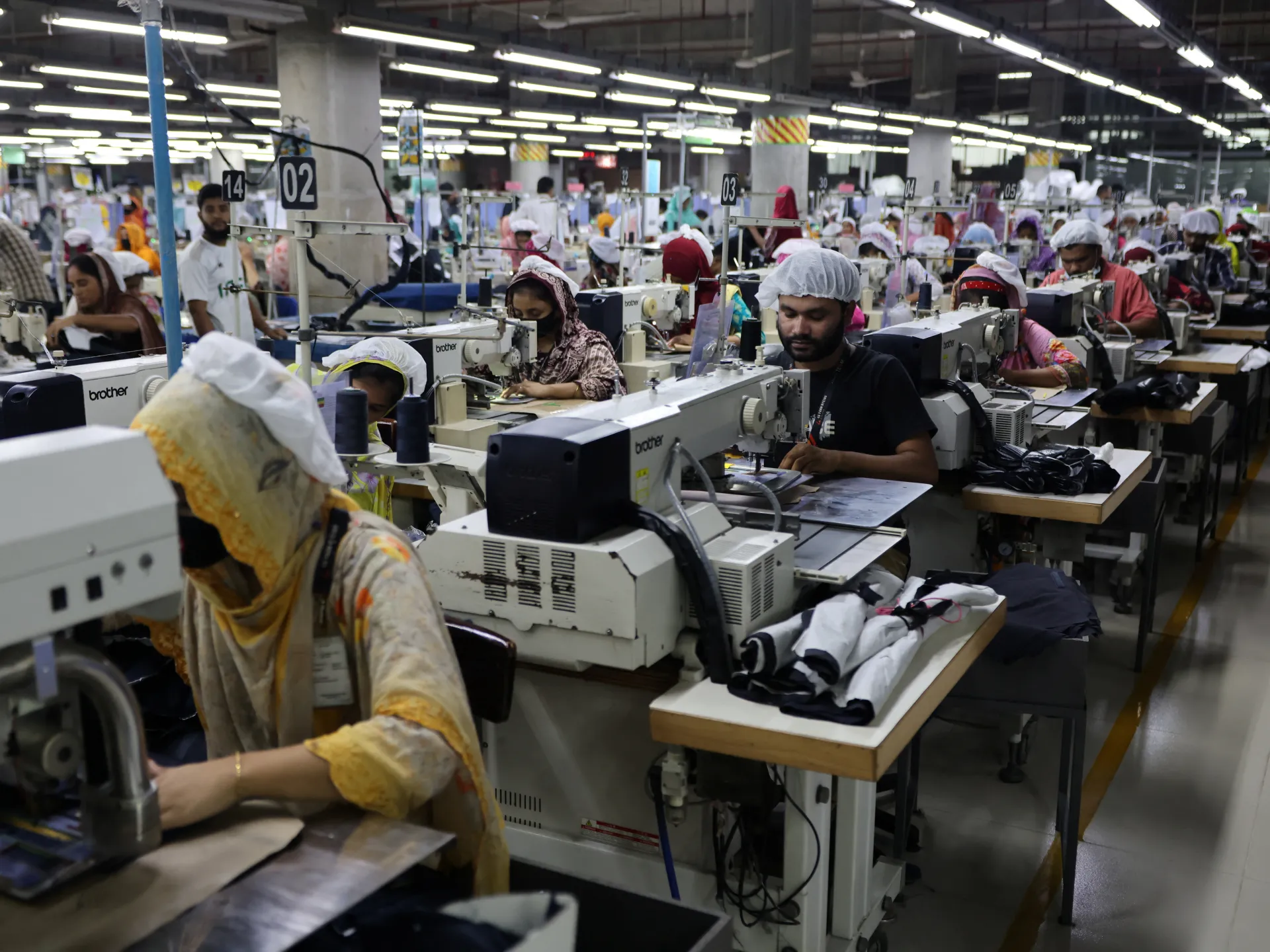
Bangladesh garment workers have staged days of protests demanding higher pay, as rising prices leave many struggling to afford food, housing and education. Demonstrations around Dhaka have disrupted hundreds of factories and led to clashes with police.
The workers are seeking a minimum monthly wage of 30,000 taka (£241), more than twice the current minimum of 12,500 taka (£102). The government has formed a six-member wage board to consider the demand, but protests continued after the announcement.
The Bangladesh Garment Manufacturers and Exporters Association said Sunday’s demonstrations disrupted operations at 529 factories and affected nearly a million workers.
In the Gazipur area north of Dhaka, workers blocked the Dhaka-Tangail highway and vandalised and set fire to vehicles on Monday. Clashes were also reported in Mirpur, while police used tear gas and stun grenades to disperse protesters in Ashulia the previous day and arrested dozens.
Laili Begum, a 37-year-old sewing operator at Virtual Bottoms Limited near Dhaka, earns about 15,000 taka a month. Overtime can lift her pay to between 18,000 and 20,000 taka, but she said it was still not enough to support her family.
Begum’s 15-year-old daughter and 12-year-old son left school earlier this year because she could no longer afford their education. She said there were days when the family could manage only one proper meal.
“We can barely afford one proper meal a day. This morning, we had only puffed rice and Bombay mix [a snack]. There was nothing for lunch. We’ve been going hungry, hoping to have a proper meal tonight. Yesterday was the same. This is how we survive now,” she said.
“My son is so thin that you can count every rib in his chest. What else can I do?”
Begum pays 3,500 taka a month for a single room shared with her mother and children, while her father, who lives in Sirajganj, also relies on her income. She said she had been burning discarded paper and other materials for cooking because she could not afford a gas cylinder costing about 2,200 taka.
Inflation deepens pressure on garment workers
The last revision of the garment sector’s minimum wage was made in December 2023. Official figures put annual inflation at 8.34 per cent in September, including 7.22 per cent for food and 9.30 per cent for non-food items.
Rasel Khan, a 30-year-old worker in Ashulia, said his monthly income of between 18,000 and 20,000 taka, including overtime, was no longer enough to support his wife, child, mother and younger brother. He has built up debts of about 100,000 taka to cover household expenses.
“It’s impossible to support a family on this income anymore. Prices keep rising, and we have to borrow money just to survive,” he said.
Zahid Hussain, a former lead economist at the World Bank’s Dhaka office, said persistent inflation over the past five years had sharply reduced the purchasing power of low-paid workers.
“When real income falls, they have to cut their daily living standards,” he said. “They don’t have any surplus income.”
Bangladesh is the world’s second-largest apparel exporter after China, with the ready-made garment industry accounting for more than 80 per cent of export earnings. The sector employs about four million people, around half of them women, and generated $39 billion in the last financial year.
Workers’ representatives say the current wage is low compared with other manufacturing centres. Garment workers in Cambodia have a minimum wage of $210 a month, while rates in Vietnam range from $140 to $210 and those in China’s Guangdong manufacturing hub from $286 to $378.
Government promises wage negotiations
The government’s wage board was announced after workers began their latest demonstrations. Labour laws have also been amended to reduce the wage review period from five years to three, with the current three-year period ending in December.
Prime Minister Tarique Rahman held an emergency meeting with senior officials on Sunday. Home Minister Salahuddin Ahmed met factory owners on Monday and said a new minimum wage would be fixed through negotiations.
Labour Minister Ariful Haque Choudhury urged workers to return to their jobs, saying the board would begin its work shortly. Babul Akhter, a workers’ representative on the board, called for new wages to take effect with January 2027 salaries and demanded the release of arrested workers and the withdrawal of cases against them.
Begum said workers remained unconvinced by the government’s assurances. “The government only makes promises,” she said. “They haven’t told us when wages will increase and by how much.”
Factory owners have warned that higher wages must be matched by fairer prices from international clothing brands. Sheikh Hossain Muhammad Mustafiz, an official at the manufacturers’ association, said workers deserved pay that supported a decent standard of living but that substantial increases could put pressure on factories without better purchasing prices.
Taqbir Huda, a senior fellow at the Tech Global Institute at the University of Oxford, said western brands buying Bangladeshi garments had a major role in determining how much value reached workers. He said the wage board would not meet workers’ demands unless it addressed inflation and the wider cost-of-living crisis.
For Begum, the immediate concern is feeding her family while negotiations continue. “Wages must rise, but food prices must also come down,” she said.
