


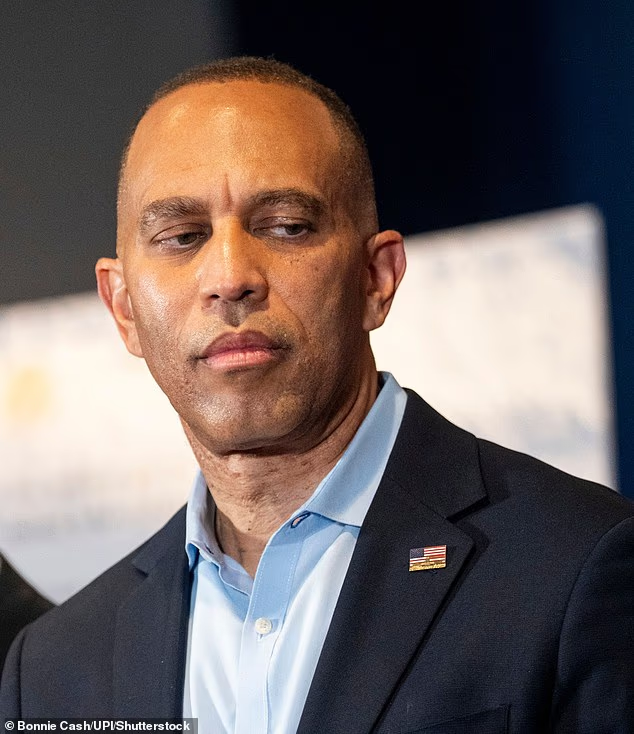
A Democratic power struggle is taking shape in Washington just days after the party’s sweeping midterm victory, with Hakeem Jeffries facing pressure from both a growing socialist faction and moderate lawmakers elected in traditionally Republican districts.
The result gave Democrats control of both chambers of Congress and put Mr Jeffries, 56, on course to become the first black Speaker of the House. He is expected to lead at least 254 Democrats – the party’s largest House majority since Barack Obama’s first year as president in 2009.
But the size and ideological breadth of the new caucus could make it difficult to maintain unity. Progressive lawmakers are demanding major changes to healthcare, immigration and foreign policy, while moderates are warning against policies that could alienate the voters who delivered the victory.
Mr Jeffries has attempted to play down the prospect of an internal revolt, saying Democrats had already shown they could withstand pressure to divide them.
“We’ve worked very hard in order to actually maintain significant unity, which we’ve managed to do in the face of tremendous pressure from the outside to try to divide us,” he said before the election.
The scale of the Democrats’ success was reportedly so unexpected that campaign officials initially suspected their election-tracking system had malfunctioned when substantial gains began appearing in Indiana.
Progressives demand a greater say
With the result confirmed, Mr Jeffries called for Democrats to focus on delivering economic relief to voters.
“We’re humbled by the outcome and we know we have to undertake with the seriousness of purpose a relentless effort to make life more affordable for everyday Americans,” he said.
Yet the party’s progressive wing is preparing to pursue a much broader programme. Six incoming lawmakers associated with the Democratic Socialists of America are backing higher taxes on wealthy Americans, Medicare for All, an arms embargo on Israel and the abolition of Immigration and Customs Enforcement.
Incoming Pennsylvania representative Chris Rabb has warned that party leaders will face consequences if they ignore what he called the populist agenda. He has also made clear that he will not automatically support Mr Jeffries in the election for Speaker.
“I’m nobody’s rubber stamp,” Mr Rabb said.
Mr Rabb was endorsed during his successful campaign by New York representative Alexandria Ocasio-Cortez, one of the Democratic Party’s most prominent democratic socialists. Her arrival alongside a larger group of like-minded lawmakers is expected to strengthen demands for a decisive shift to the left.
The relationship between Mr Jeffries and the socialist wing has already been strained by disagreements over Israel. His relationship with New York City mayor Zohran Mamdani was also difficult before the mayoral election, with Mr Jeffries delaying his endorsement over what he described as “areas of principled disagreement”.
Washington representative Pramila Jayapal has separately criticised Mr Jeffries for not placing Medicare for All at the centre of the Democratic agenda.
“He can be at the front of that and I hope he is, otherwise it will turn into a fight,” she said.
Moderates warn against Republican-style infighting
Moderate Democrats are equally determined to prevent the party’s direction being set by its most left-wing members. The New Democrat Coalition, led by Illinois representative Brad Schneider, expects to include about 140 House members and wants inflation and the cost of everyday essentials to take priority.
Mr Schneider cautioned against the sort of public factional warfare that repeatedly disrupted Republicans when they controlled the House.
“Hopefully, there won’t be folks… throwing verbal Molotov cocktails and trying to burn things down,” he said.
Texas representative Henry Cuellar also urged Democrats not to repeat the leadership disputes that weakened former Republican Speaker Kevin McCarthy and his successor, Mike Johnson.
“It’s a mistake,” Mr Cuellar said of attempts by factions to exert disproportionate influence. “They weakened McCarthy. They weakened Johnson, and we’re smarter than that.”
The contrast between the party’s competing electoral strategies is illustrated by James Talarico, the 37-year-old Democrat who defeated Trump-backed Ken Paxton in the Texas Senate race.
The former teacher became the first Democrat elected to the Senate from Texas since 1988 after campaigning on reducing living costs, tackling corruption and appealing to independent and moderate voters. Although progressive on economic issues, he softened some of his positions on contentious social questions during the campaign.
His victory adds another prominent voice to a party debating how far left it should move after its strong performance.
Democrats plan investigations of Trump administration
Alongside the internal debate over policy, Democrats are preparing to use their new congressional power to investigate Donald Trump, members of his family and senior figures in his administration.
Incoming House Oversight Committee chairman Robert Garcia has outlined plans to examine the Trump family’s business dealings, presidential advisers and corporate donors. After Mr Trump announced that Stephen Miller would become his new White House chief of staff, Mr Garcia issued a blunt warning.
“Stephen Miller should lawyer up,” he said.
Democrats are divided, however, over whether to pursue impeachment proceedings against the president. Some lawmakers want to take that step, while others fear it could alienate the swing voters who helped deliver their sweeping victory.
Mr Jeffries said that nobody in his caucus had raised impeaching Mr Trump with him. Instead, he wants the new Congress to begin work on healthcare costs, restoring Medicaid and food assistance benefits, reversing Mr Trump’s tariffs and ending the war in Iran.
Even with control of both chambers, Democrats will face significant obstacles. Their Senate majority will not automatically provide the 60 votes generally needed to overcome a filibuster, while Mr Trump retains the power to veto legislation.
Mr Jeffries’ ability to keep the sprawling caucus together will therefore be central to his leadership. California representative Jared Huffman said managing it would be “an enormously difficult job”, describing the group as “a big and sometimes unruly caucus”.
For now, the size of the Democratic majority gives the presumptive Speaker more room for manoeuvre than Republican leaders previously enjoyed. But the first test may come before Congress begins its legislative work, as progressives and moderates compete to shape the party’s priorities.
