


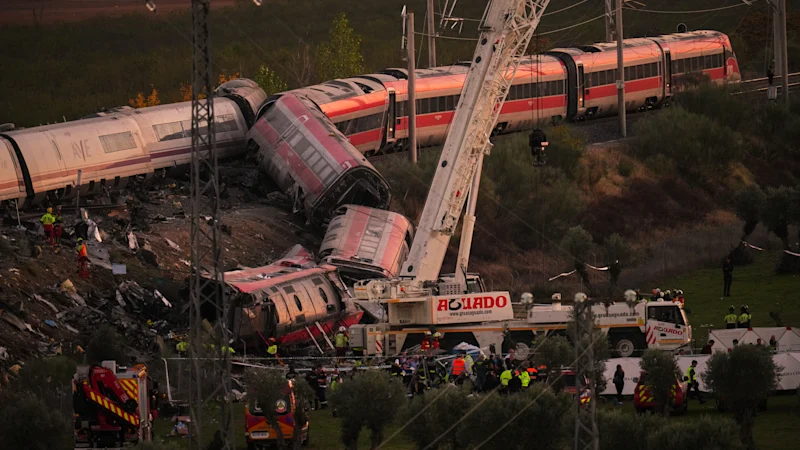
Two Australians have been confirmed among the 69 people killed in last week’s train crash in Spain, after authorities formally identified all the victims.
The Tribunal Superior de Justicia de Castilla-La Mancha, which is overseeing the judicial investigation and legal response, announced the identifications on Tuesday.
The disaster occurred on the railway line south of Madrid, where a high-speed Renfe AVE train collided with the rear of an Iryo service that was stationary on the tracks. Almost 200 people were injured.
Australia’s Department of Foreign Affairs and Trade said on Friday that diplomats were supporting the families of two Australians in connection with the crash. The department offered its “heartfelt condolences” to everyone affected but did not comment at the time on the fate of those involved.
Investigation into Spain train crash continues
Most of those killed were Spanish nationals, with 54 victims identified as Spanish. The other foreign nationals identified among the dead included four Americans, two Japanese and one person each from Canada, France, Argentina, Mexico, Portugal, Tunisia and the Czech Republic.
Spanish Transport Minister Óscar Puente has blamed human error, saying a control centre in Madrid failed to warn the driver of the Renfe service that another train was ahead on the line.
His comments prompted an angry response from rail unions, which accused him of “scapegoating” control workers and called for his resignation. The two operators have also given differing accounts of what drivers had been told.
The Renfe train was carrying 397 passengers, while the Iryo service had 147 passengers on board.
The collision in Toledo province happened nine months after another crash farther south on the same Madrid-Seville route, in which 46 people died. The incidents have undermined confidence in a rail network long regarded as both fast and safe.
Prime Minister Pedro Sánchez has promised an investigation and measures to restore trust in the system, which carried about 45 million travellers last year, including millions of tourists.
