


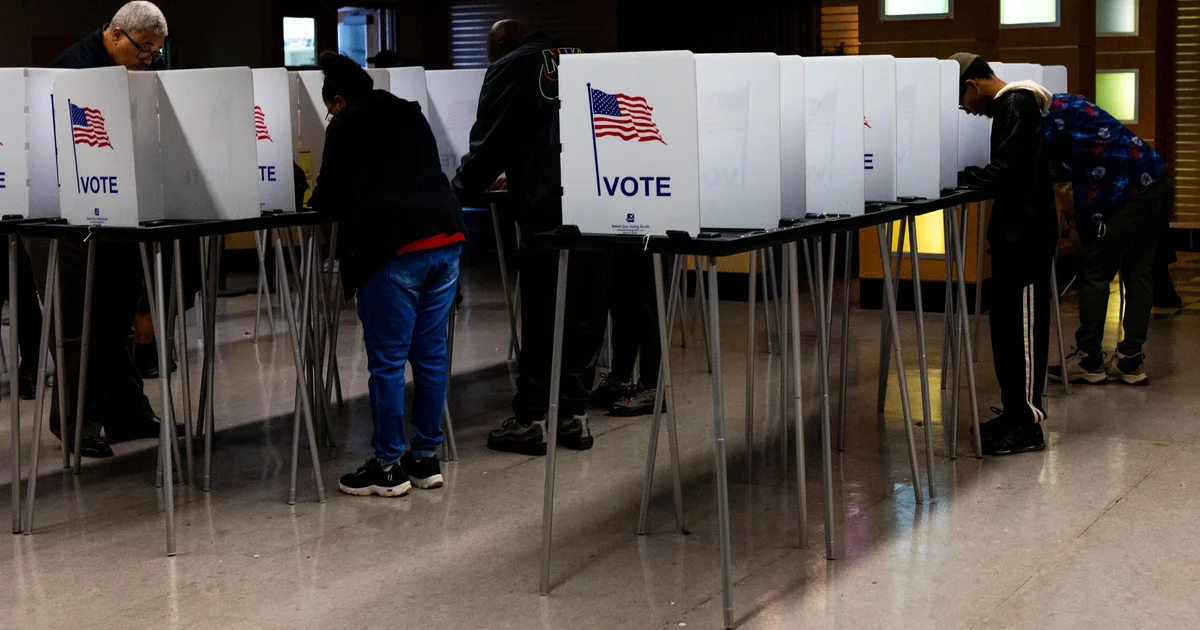
American voters are deciding control of Congress, 36 governorships and a wide range of major policy measures in the 2026 midterm elections.
All 435 seats in the House of Representatives and 35 of the 100 Senate seats are being contested, while voters in states including California, Arizona, Colorado, Nevada, Missouri, Idaho and Virginia are also considering proposals on tax, abortion rights, electoral rules and redistricting.
Midterm elections take place halfway through a president’s four-year term. Although the president is not on the ballot, they often become a test of public support for the administration and the party controlling Washington.
House majority rests on a handful of contests
Republicans entered polling day with a three-seat majority in the House, leaving both parties with little room for error. Historically, the party occupying the White House has struggled to gain House seats in midterm elections, with the last such increase taking place in 2002.
Pennsylvania is expected to provide an early indication of the night’s direction. Four Republican-held districts in the Philadelphia suburbs, the Lehigh Valley and central Pennsylvania are being closely watched, with Democratic victories in all four potentially putting the party within reach of a majority.
In New York’s Hudson Valley, two-term Republican Mike Lawler is defending the 17th Congressional District against Democrat Cait Conley. Lawler has won the seat by fewer than 30,000 votes in each of the past two elections, while the district backed Kamala Harris in 2024.
Iowa is another important battleground. Republicans hold all four of the state’s House seats, but three are considered competitive. Mariannette Miller-Meeks is defending the south-eastern 1st District, where she won by only six votes in 2020, while Zach Nunn is seeking a third term in the 3rd District.
The open 2nd District features Republican Joe Mitchell, aged 29, against Democrat Lindsay James, aged 42. The seat is being contested after its current representative, Ashley Hinson, moved into the Senate race.
Arizona’s 1st District pits former NFL kicker Jay Feely against physician Amish Shah, who narrowly lost there in 2024. In the 6th District, Republican incumbent Juan Ciscomani is seeking another term after holding the seat by fewer than three percentage points in each of the last two elections.
Colorado could produce two very different outcomes. In Denver’s heavily Democratic 1st District, 29-year-old Melat Kiros is expected to become the first Gen Z member of Congress after defeating long-serving representative Diana DeGette in the primary. Republican Lauren Boebert, meanwhile, is facing a closer-than-expected contest against Democrat Eileen Laubacher in the strongly Republican 4th District.
California Democrats are seeking to benefit from newly redrawn congressional boundaries intended to help them capture five Republican-held seats. Among the closely fought contests is the Central Valley’s 22nd District, where Republican incumbent David Valadao faces Democrat Randy Villegas.
Texas is also central to the battle for the House. Republicans are defending gains made among Latino voters in 2024, including in the Corpus Christi-based 15th District, where Monica De La Cruz is facing Latin Grammy-winning musician Bobby Pulido.
In a newly redrawn district near San Antonio, Democrat Johnny Garcia is attempting to defeat Republican Carlos De La Cruz. Democrats are also defending the Laredo-area 28th District and the 34th District, both of which have been redrawn to make them more favourable to Republicans.
Senate control could turn on 11 battlegrounds
Republicans are defending a 53-47 Senate majority, with the outcome expected to hinge on 11 closely contested races.
Democrat Jon Ossoff is regarded as well placed to retain his seat in Georgia against Republican congressman Mike Collins. North Carolina is moving in the opposite direction, with former Democratic governor Roy Cooper leading the contest for the seat being vacated by Republican Thom Tillis.
Maine Republican Susan Collins is facing one of the toughest re-election campaigns of her 29-year Senate career. The Appropriations Committee chair is seeking a sixth term against former state Senate president Troy Jackson, who replaced Graham Platner on the ballot.
Alaska has an unusual three-way contest, with Democrat Mary Peltola facing Republican incumbent Dan Sullivan and another candidate named Daniel J. Sullivan. Republicans have argued that the second candidate could draw votes from the incumbent, while allegations that Peltola-linked operatives recruited him to confuse voters have been denied by her campaign.
Ohio offers Democrats a chance to regain a Senate seat in a state that has moved towards the Republicans. Former Democratic senator Sherrod Brown is challenging Republican Jon Husted for the final two years of JD Vance’s term, with Brown holding a narrow lead in recent polling despite Donald Trump winning Ohio by more than 11 points in 2024.
Texas, Iowa and Kansas are also competitive despite decisive Republican victories in the 2024 presidential election. In Texas, Democratic state representative James Talarico is challenging Republican attorney general Ken Paxton, while Iowa Republican Ashley Hinson faces Democratic state representative Josh Turek for the seat being vacated by Joni Ernst.
Kansas Democrat Adam Hamilton is challenging Republican Roger Marshall, and has led by as many as nine points in recent polling. Michigan could instead give Republicans a gain, with former congressman Mike Rogers facing Democrat Abdul El-Sayed for the seat being vacated by Gary Peters.
A victory for El-Sayed would make him the first Muslim American elected to the Senate. A Rogers win would be the first Republican Senate victory in Michigan since 1994.
Governors’ races draw national attention
Several of the 36 governors’ contests are taking place in states likely to matter in the 2028 presidential election.
In Georgia, former Atlanta mayor Keisha Lance Bottoms is challenging Republican Rick Jackson for the seat being vacated by term-limited governor Brian Kemp. Democrats have not won the governorship since 1998; a Bottoms victory would also make her the first Black woman elected governor in American history.
Iowa state auditor Rob Sand is seeking to defeat Republican farmer Zach Lahn and take the governorship from the retiring Kim Reynolds. Sand, the only Democrat currently holding statewide office in Iowa, has campaigned on his bipartisan credentials and maintained a lead in polling since the summer.
Michigan secretary of state Jocelyn Benson is facing Republican congressman John James, while Wisconsin’s Milwaukee County executive David Crowley is competing against Republican congressman Tom Tiffany. Both states backed Trump in 2024 after voting for Joe Biden in 2020.
Ohio’s contest has drawn particular attention after Republican entrepreneur Vivek Ramaswamy’s campaign released an advert featuring the estranged mother of Democrat Amy Acton, the state’s former health director. The advert provoked criticism from both parties and was defended by Ramaswamy and Mr Trump before being withdrawn shortly before polling day.
Ballot measures cover tax, abortion and voting rules
Voters are also deciding dozens of statewide and local measures, including proposals on abortion rights, voting requirements, congressional boundaries, taxation and the powers of government.
California’s Proposition 40 would impose a one-off 5% tax on billionaires living in the state. Supporters say it could raise tens of billions of dollars for healthcare, food assistance and education, but the proposal has divided Democrats, with Bernie Sanders backing it and outgoing governor Gavin Newsom opposing it.
Redistricting proposals in Maryland and Missouri could alter the way congressional maps are drawn and affect the balance of power in Washington. California, Arizona, Colorado and Nevada are considering stricter voter identification requirements, while Alaska is voting on whether to repeal its ranked-choice voting system.
Abortion rights remain a major issue more than four years after the Supreme Court overturned Roe v Wade. Missouri voters are considering whether to repeal a constitutional protection for reproductive freedoms, while Idaho and Virginia are voting on measures that would protect abortion rights until fetal viability, with some later restrictions permitted in Virginia.
Local voters are also being asked to decide how the rapid expansion of data centres should be managed. More than 40 measures across more than a dozen states concern construction, zoning or approval requirements, including more than 20 proposals in communities across Ohio.
