


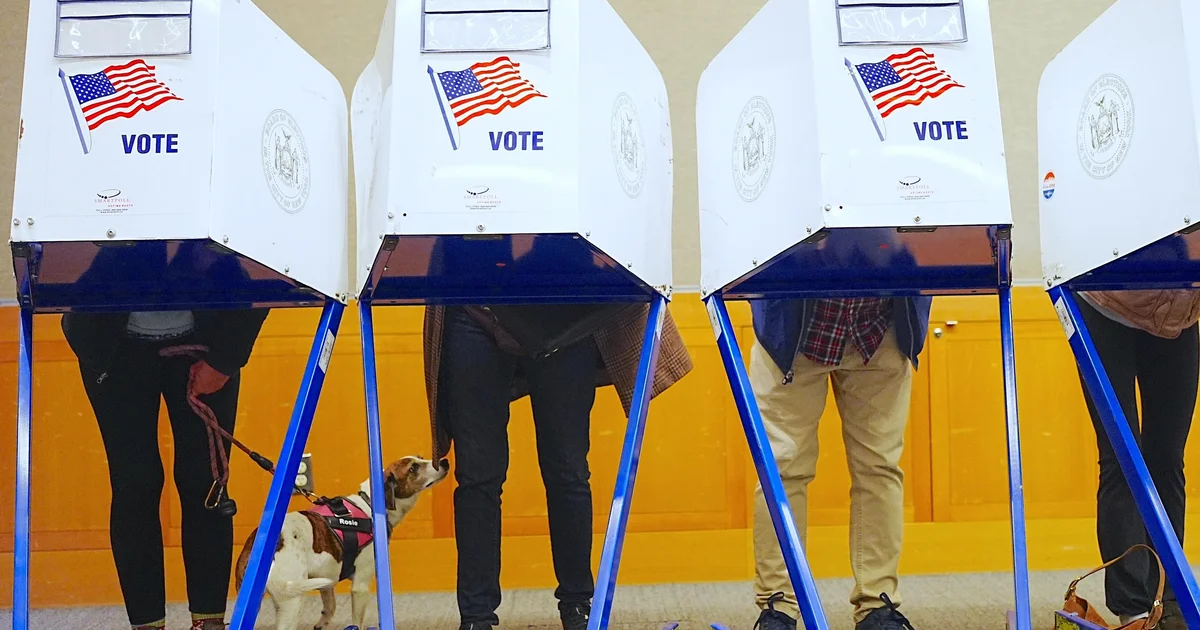
Millions of Americans are voting in the 2026 midterm elections, with more than 57 million ballots cast early. All 435 seats in the House of Representatives are being contested, alongside Senate races in 35 states, gubernatorial elections in 36 states and more than 150 ballot measures across 40 states.
The outcome will help determine the direction of Donald Trump’s presidency during its final two years, including whether Congress approves further funding for the Iran War and whether proposals for regulating artificial intelligence advance.
Brody Saner, a college student in Kansas, said voting was a responsibility. “If there’s something you’re not happy with, go out and vote. Do your part to change it.”
Why the 2026 midterm elections matter
Midterm elections traditionally attract fewer voters than presidential contests. In 2022, 46% of eligible voters cast ballots, compared with 65% in the 2024 presidential election.
That lower turnout can give individual votes greater significance, particularly when contests are decided by narrow margins. Republican congresswoman Lauren Boebert retained her Colorado seat by 546 votes in 2022, while Democrat Adam Gray won California’s 13th Congressional District by 187 votes in 2024. In 2020, Republican Mariannette Miller-Meeks won her Iowa House race by six votes.
Donald Green, a Columbia University political scientist who has studied voting for three decades, said midterms could be “arguably more opportune moments for voters to get what they want” because relatively small changes in the vote can produce major shifts in policy.
He said the impact of an election was not only determined by individual ballots, but by which groups turned out. Politicians, he argued, pay close attention to groups with high voting rates, while the concerns of young and poorer people can receive less attention when those groups vote less frequently.
For Kansas voter Tracy Preisser, the principle was straightforward: “Your vote is your voice.” At national level, voters are deciding which party controls the House and Senate, and whether Congress acts as a check on presidential power or enables the White House during the remainder of Mr Trump’s term.
State and local elections will also affect everyday issues, including taxes, school funding, the cost of a doctor’s visit and the judges who sit on local courts.
Yet a CBS News/YouGov poll found that most voters did not believe either party had a plan to make people better off. Most also said they would not be financially better off whichever party won, a view that has led some to consider staying away from the polls.
“I just don’t trust anybody at this point enough to vote for them, Republican [or] Democrat,” said Kansas farmer Mandy Sieren. “I think they’re all crooked.”
Mr Green said dissatisfaction with both parties still left voters with a decision to make. “Although they might be dissatisfied with both parties, typically it comes down to the candidates themselves, and [voters] have to make an informed choice one way or the other,” he said.
Control of Congress and the states
History suggests the president’s party faces a difficult test in midterms: it has lost seats in 37 of the past 41 such elections. This year, control of both chambers of Congress is at stake, with Republicans holding only a narrow House majority.
Democrats need a net gain of three House seats to take control. They require four additional Senate seats to win that chamber, giving the result immediate consequences for legislation and the extent of congressional scrutiny of the president.
More than 30 states are also choosing governors, with competitive races in places including Georgia and Ohio. Governors can influence the expansion of data centres by approving moratoriums, deciding on tax breaks and appointing utility commissioners. There are also 41 ballot initiatives concerning data centres across 13 states.
In New York City, poll worker Sandra Strother said family history motivated her not only to vote but to help others do so. She said her uncle, an African American man, was killed while trying to vote in Alabama in the 1950s.
“That’s my great motivator,” she said.
