


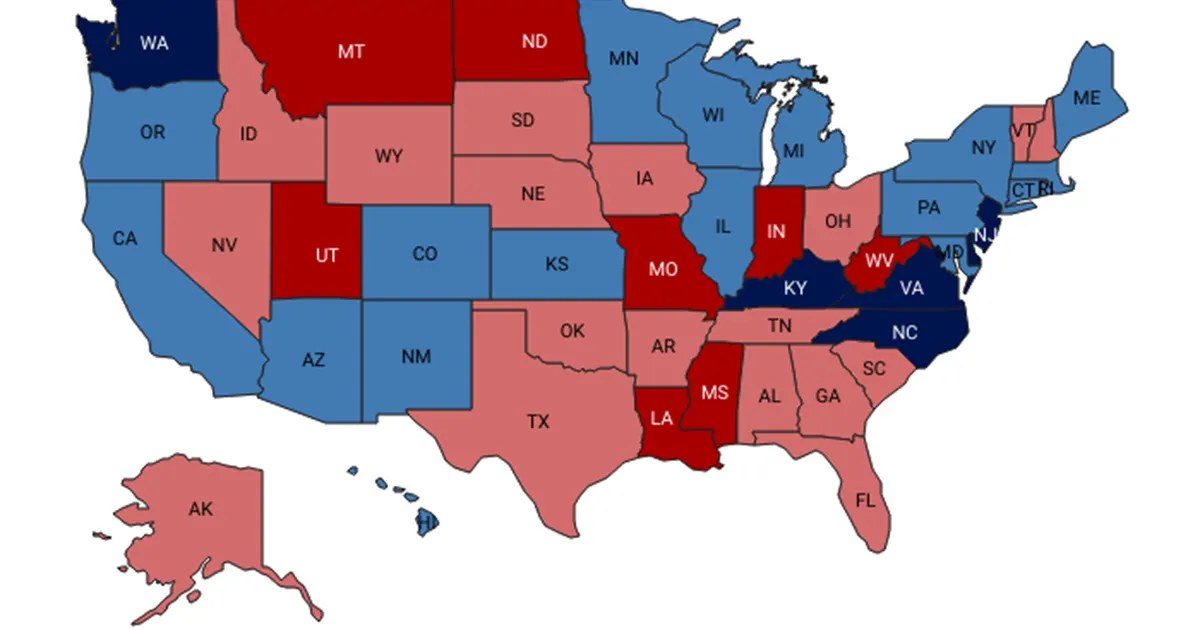
The 2026 US midterm elections will feature 36 races for governor, but the battle for control of state capitals is expected to hinge on only a small number of closely fought contests. Republicans currently hold 26 governorships to the Democrats’ 24, leaving the party’s long-standing advantage vulnerable in states including Georgia, Nevada and Wisconsin.
The outcome will be watched alongside the fight for control of Congress, but gubernatorial elections carry their own significance. Governors influence taxation, healthcare, education, abortion policy and election administration, while victories in several states could give either party a majority of governorships for the first time in more than a decade.
Republicans have held more governors’ offices than Democrats since 2010. Their advantage peaked in 2018, when the party controlled 33 seats compared with 16 for the Democrats and one held by an independent. Since then, Democratic gains have narrowed the gap to just two seats.
Election analysts rate Georgia, Nevada and Wisconsin as toss-ups, despite Republican control of the governor’s office in the first two states and Democratic control in Wisconsin. Florida, Kansas and Texas are viewed as leaning Republican, leaving the central contest concentrated among a handful of battlegrounds.
Georgia governor race becomes a test of Republican dominance
Georgia Republicans are attempting to retain the governor’s office after more than two decades of control, while Keisha Lance Bottoms is seeking to become the first Democrat elected governor in the state since 1998.
Ms Bottoms, the former mayor of Atlanta, is facing Republican nominee Rick Jackson, a healthcare executive who spent more than $100 million of his own money to defeat Burt Jones in the Republican primary. Mr Jackson prevailed despite President Donald Trump backing his rival.
The race has also acquired historic significance. Ms Bottoms could become the first Black woman elected governor anywhere in the United States, a milestone also within reach for Republican Lisa Demuth in Minnesota. The Associated Press has reported that all 83 governors Georgia has had since 1776 have been white men.
Mr Jackson has campaigned on cutting taxes, freezing property taxes and using technology to reduce government waste. He has also proposed freezing tuition, accommodation and board costs at public colleges and technical schools.
Ms Bottoms has made healthcare access and affordability central to her campaign. She supports expanding Medicaid, saying the move would cover about 300,000 uninsured Georgians, and has also backed a $15 minimum wage and tuition-free community and technical colleges.
Nevada contest pits vulnerable Republican against Democratic statewide winner
In Nevada, Republican governor Joe Lombardo is seeking a second term against Democratic Attorney General Aaron Ford, who has already won statewide elections in 2018 and 2022.
The contest is regarded as one of the most competitive governor’s races in the country. Housing costs, energy demand from artificial-intelligence data centres and the effect of federal spending reductions on state programmes are prominent concerns for voters.
Mr Lombardo defeated Democratic governor Steve Sisolak in 2022, but Nevada remains politically fluid. Donald Trump carried the state in the last presidential election by three percentage points, the first Republican victory there in a presidential contest for 20 years.
Mr Lombardo has pointed to job growth and billions of dollars in new funding approved during his first term. His campaign has also highlighted investment in housing and the 160 vetoes he has issued since taking office.
Mr Ford has focused on the housing crisis and healthcare costs, proposing measures aimed at curbing speculative property purchases and easing restrictions on new construction. He has also promised investigations into pharmacy benefit managers, which he has accused of acting in a predatory manner.
A third candidate, Danielle Ford, is running as a non-partisan contender. The former Clark County School District trustee has made education, public safety, healthcare and affordability the main pillars of her campaign.
Ohio Democrats attempt to end two-decade losing streak
Ohio is no longer considered the swing state it once was. Republicans control both chambers of the state legislature, every statewide elected office and both US Senate seats, while Democrats have not won the governorship for 20 years.
The party’s nominee, Amy Acton, is nevertheless seeking to exploit concerns over prices, healthcare and the impact of data centres on rural communities. She is challenging Vivek Ramaswamy, the Republican businessman and former presidential candidate endorsed by Mr Trump.
Dr Acton, who was Ohio’s health director during the early stages of the Covid-19 pandemic, is targeting rural voters who have traditionally supported Republicans but are increasingly worried about household costs and the future of local hospitals.
Her platform includes lower taxes for working people, reduced utility bills and broader access to healthcare. She has also adopted positions intended to appeal to conservative voters, including opposition to transgender athletes competing in women’s sport and support for cooperation between local law enforcement and federal immigration authorities.
Mr Ramaswamy has promised property-tax reductions and begun advocating the eventual abolition of Ohio’s state income tax. He has also promoted increased natural-gas production and fracking as a means of lowering electricity bills, while pledging to protect the state’s water and other natural resources.
Libertarian candidate Don Kissick is campaigning against new data centres until stricter standards are introduced. He has also criticised the use of automated licence-plate readers and surveillance cameras.
Wisconsin race centres on costs and control of government
Wisconsin offers Democrats an opportunity to retain the governorship after Tony Evers decided not to seek a third term. Milwaukee County executive David Crowley is facing Republican congressman Tom Tiffany in a state where Republicans control the legislature but Democrats retain several key statewide offices.
The contest is being fought largely on the cost of living. A September Marquette Law School poll found that 45% of Wisconsin voters regarded inflation and household costs as their most important issue, far ahead of border security, the next most frequently cited concern.
A later Marquette survey put Mr Crowley ahead of Mr Tiffany by 51% to 44% among likely voters, although the difference remained within the poll’s margin of error. The survey also found that independent voters had moved towards Mr Crowley, while many remained undecided.
Mr Crowley, who would become Wisconsin’s first Black governor, has proposed allowing all residents to buy into BadgerCare, the state’s Medicaid programme, with premiums linked to income. He has also called for more housing and tighter conditions on the construction of data centres, including requirements for investment in the electricity grid.
Mr Tiffany has secured Mr Trump’s endorsement and is campaigning on an eight-point plan that includes a property-tax freeze and the removal of income tax on tips and overtime. He has opposed subsidies for new data centres while agreeing that local authorities should have the final say over whether they are built.
With voting already under way in Wisconsin and the wider midterm campaign entering its final stage, the governor’s races are likely to be decided by turnout, independent voters and economic concerns rather than by the sheer number of contests on the ballot.
